Home › Articles › Punjab election 2027
Editorial note: This is an independent analysis of public reporting and published historical and survey data. It is not an official forecast and carries no seat projection. The 12 November opinion poll predates the 24 November BJP–SAD alliance announcement.
The big development: BJP and Shiromani Akali Dal reunite
The Bharatiya Janata Party (BJP) and the Shiromani Akali Dal (SAD) announced on 24 November 2026 that they will contest the 2027 Punjab Assembly election together, ending a six-year separation. The announcement was made at the BJP headquarters in New Delhi, on Guru Purab, by Union Home Minister Amit Shah, BJP president Nitin Nabin and SAD president Sukhbir Singh Badal.
The split came in September 2020, when SAD left the BJP-led National Democratic Alliance over the Centre's three farm laws, which were later repealed. As recently as March 2026, Shah had said the BJP would fight the 2027 Punjab election on its own strength. The reunion restores an old partnership, but it does not by itself show how voters will respond or how votes will move between the two parties.
According to reports of the press conference, Shah said SAD would be the "big brother" in the alliance and that the Chief Minister would come from the Akali Dal. Reports say the parties will contest all 117 seats between them, but no constituency-wise seat-sharing formula was announced. Some reports, citing unnamed sources, say the BJP may contest around 40 seats. That figure is a reported negotiating possibility, not a confirmed or signed arrangement.
Why it matters: SAD brings an established regional organisation and a historical rural network; the BJP brings a separate vote base and a national organisation. The outcome will depend on whether those electorates transfer to a common candidate, whether local workers cooperate, and how voters view the reconciliation after the farm-law dispute.
Punjab at a glance
| Indicator | Figure |
|---|---|
| Assembly constituencies | 117 |
| Majority mark | 59 |
| Final electoral roll (12 Oct 2026) | 2,01,00,727 electors |
| Male electors | 1,03,76,026 |
| Female electors | 97,24,195 |
| Third-gender electors | 506 |
| Polling stations after the roll revision | 25,332 (up from 24,453) |
| 2022 Assembly turnout | 72.15% |
| 2022 AAP seats | 92 |
The final roll, published after the 2026 Special Intensive Revision (SIR), recorded 2.01 crore electors. That is 13.60 lakh (6.33%) fewer than the 2.14 crore electors before the revision and 3.64% more than the draft roll of 13 August. 7,97,263 electors were added during the exercise. The roll counts registered voters; it is not a prediction of turnout.
Assembly election 2022: the baseline
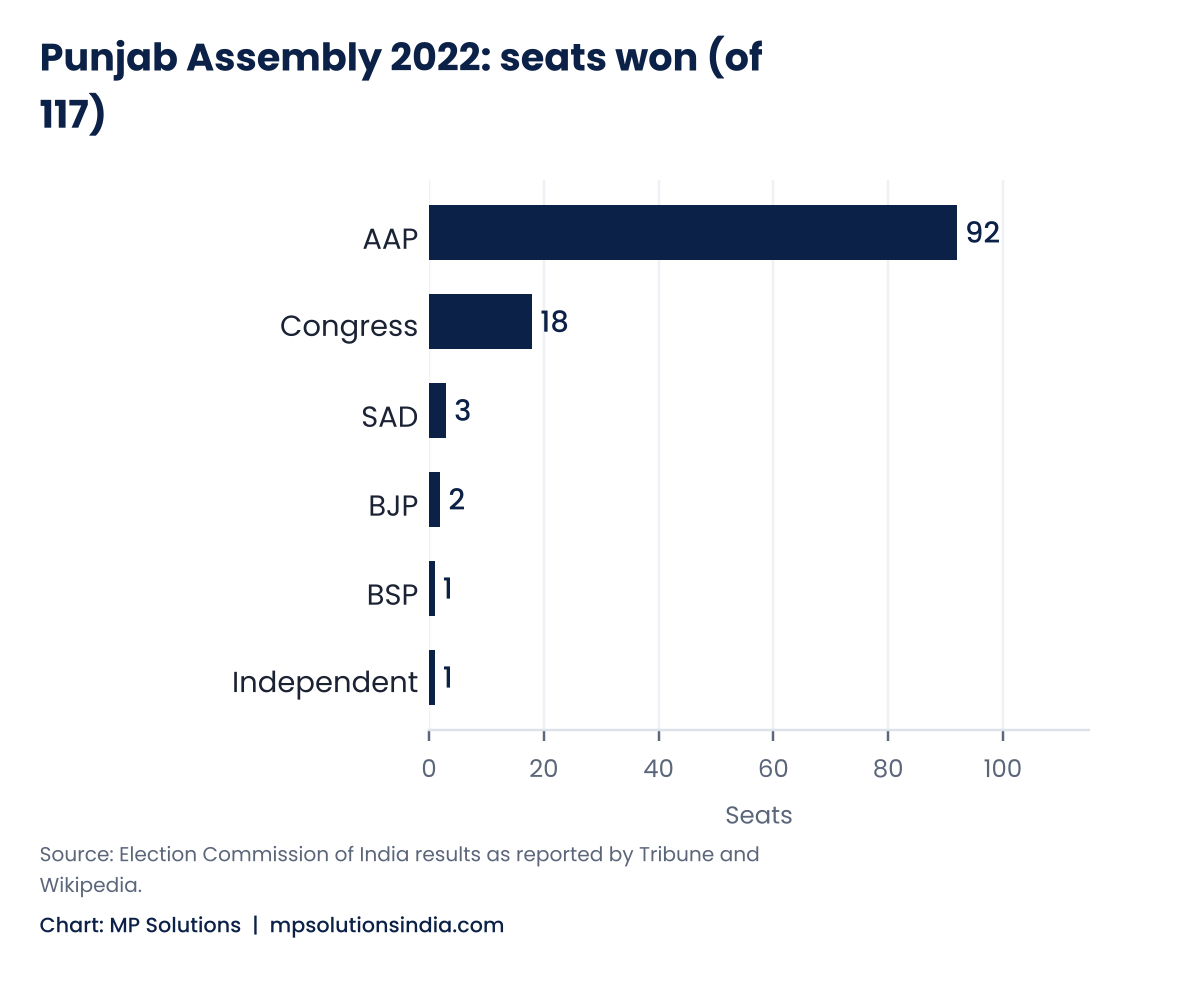
AAP won 92 of Punjab's 117 seats in 2022, with 42.01% of the vote. Congress won 18 seats with 22.98%; SAD won three with 18.38%; the BJP won two with 6.60%. The BSP and one independent candidate won one seat each.
| Party | Vote share | Seats won |
|---|---|---|
| AAP | 42.01% | 92 |
| Congress | 22.98% | 18 |
| SAD | 18.38% | 3 |
| BJP | 6.60% | 2 |
| BSP | 1.77% | 1 |
| Independent | — | 1 |
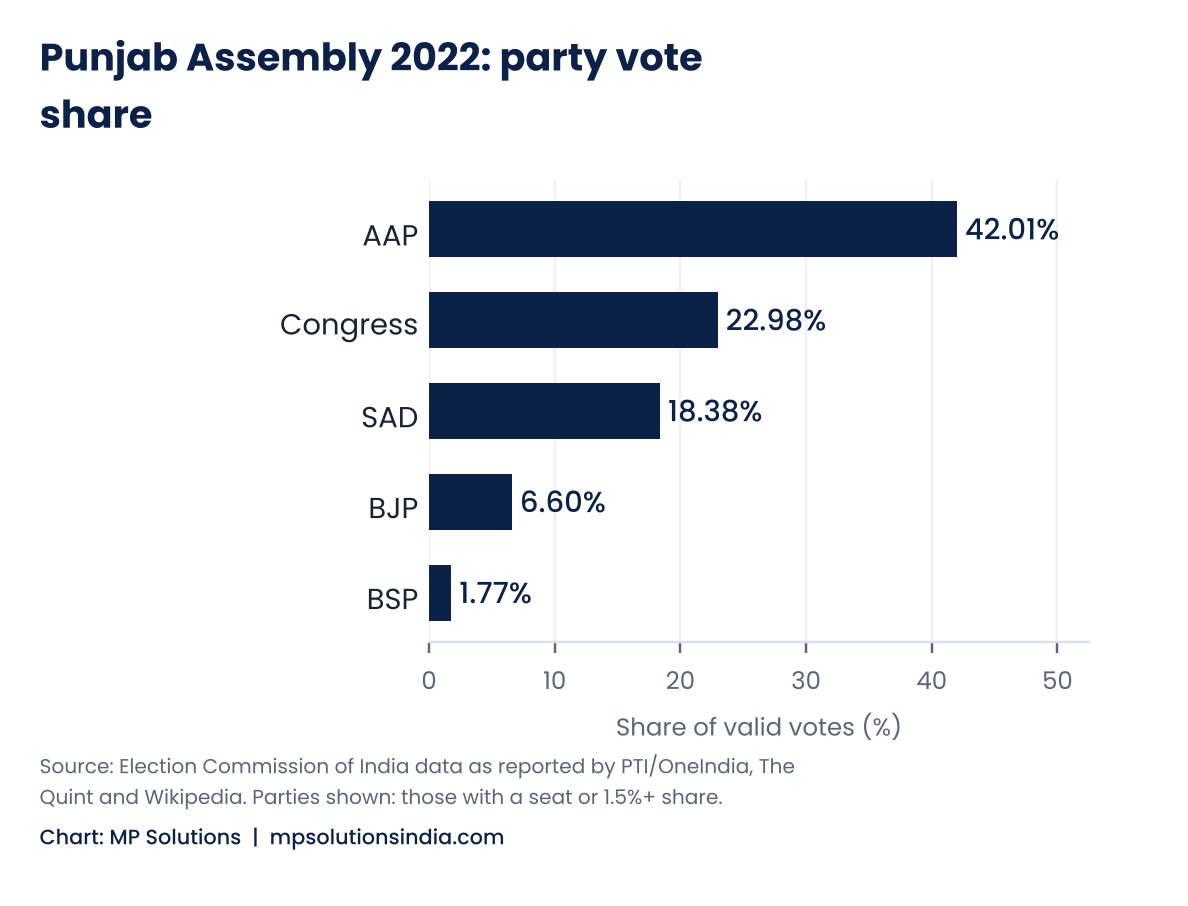
A caution on alliance arithmetic. SAD's 18.38% and the BJP's 6.60% in 2022 add up to 24.98%. That is only a historical reference, not a 2027 alliance vote-share forecast. The parties contested different constituencies, and supporters may not transfer uniformly when they share candidates.
Lok Sabha election 2024: a second electoral signal
The 2024 parliamentary election in Punjab was far more evenly split. Congress won seven of the state's 13 seats, AAP three and SAD one, and two independents also won. The BJP won no seat but took 18.56% of the vote, up from 6.60% in the 2022 Assembly election. Congress finished 0.28 percentage points ahead of AAP.
| Party | Vote share | Seats won |
|---|---|---|
| Congress | 26.30% | 7 |
| AAP | 26.02% | 3 |
| BJP | 18.56% | 0 |
| SAD | 13.42% | 1 |
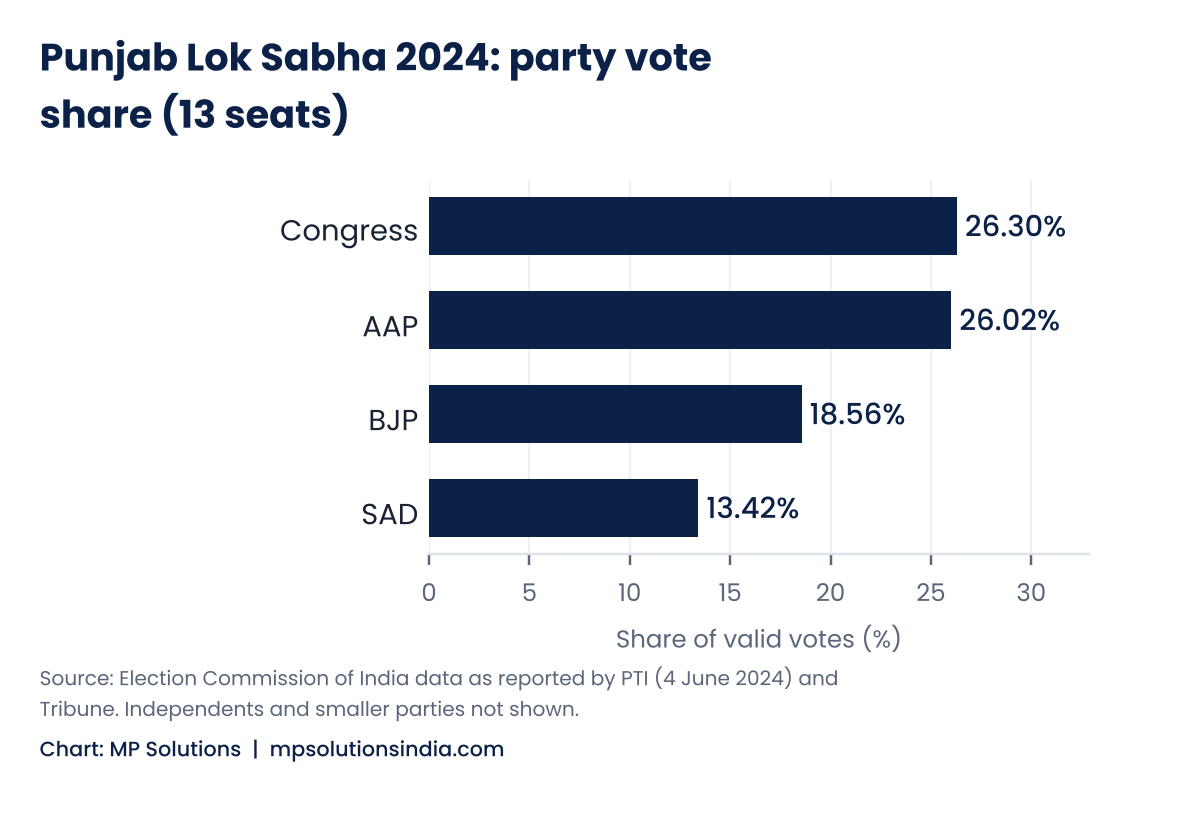
Election Commission data, as reported by PTI, showed AAP leading in only 33 of the 117 Assembly segments in the 2024 Lok Sabha contest. A parliamentary vote is not interchangeable with an Assembly vote: candidates, alliances, local issues and turnout all differ. It does show, though, that the BJP's statewide share in 2024 was materially higher than in 2022, and that the 2022 map should not be assumed to repeat.
For reference only, the 2024 shares of the BJP (18.56%) and SAD (13.42%) add up to 31.98%. Like the 2022 sum above, this is arithmetic, not a forecast.
November 2026 opinion poll: what it says, and what it cannot say
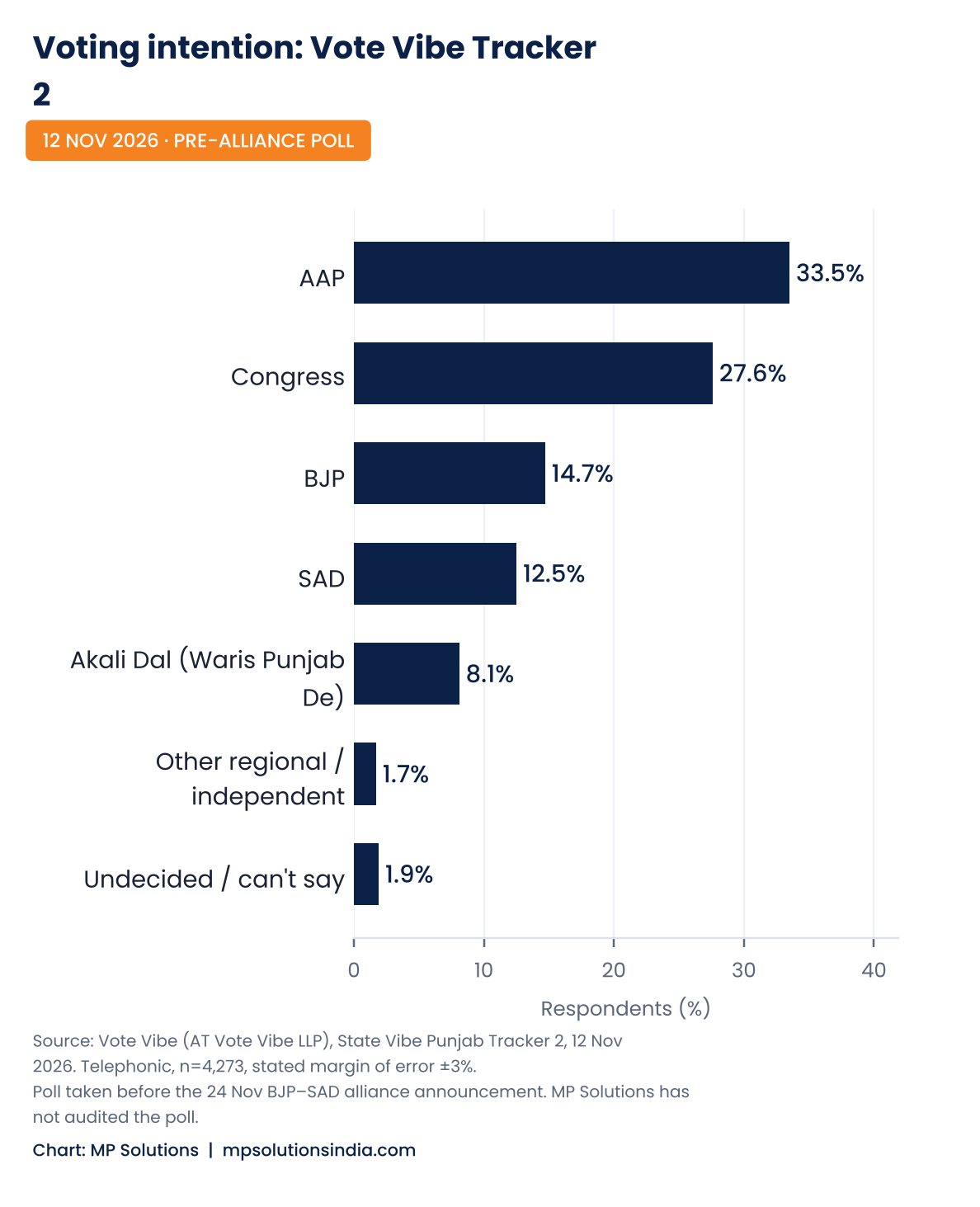
Vote Vibe's State Vibe: Punjab Assembly Elections 2027, Tracker 2, dated 12 November 2026, reported the following voting intention.
Methodology, as disclosed by the poll publisher (AT Vote Vibe LLP): telephonic interviews; sample size 4,273 across Punjab; stated margin of error ±3%. The slides carry a single date, 12 November 2026, and no separate fieldwork dates.
MP Solutions reports the publisher's disclosed method. We have not independently audited the sampling frame, weighting, questionnaire, fieldwork or raw data.
| Party / response | Voting intention |
|---|---|
| AAP | 33.5% |
| Congress | 27.6% |
| BJP | 14.7% |
| SAD | 12.5% |
| Akali Dal (Waris Punjab De) | 8.1% |
| Other regional / independent | 1.7% |
| Undecided / can't say | 1.9% |
The poll also asked which party respondents thought would win. That is a separate question from voting intention.
| Party / response | Perceived winner |
|---|---|
| AAP | 33.7% |
| Congress | 23.1% |
| BJP | 16.3% |
| SAD | 12.3% |
| Akali Dal (Waris Punjab De) | 6.6% |
| Other regional / independent | 1.5% |
| Undecided / can't say | 6.4% |
Crucial timing limitation. The poll's date, 12 November, is twelve days before the BJP–SAD announcement on 24 November. The BJP and SAD figures must therefore not be added together and described as a measured post-alliance vote share. The poll did not test the new alliance as a single option.
Preferred Chief Minister in the same poll
| Name (party association) | Preference |
|---|---|
| Bhagwant Mann (AAP) | 35.9% |
| Charanjit Singh Channi (Congress) | 19.0% |
| Sukhbir Badal (SAD) | 14.6% |
| Kewal Singh Dhillon (BJP) | 10.1% |
| Amritpal Singh (Waris Punjab De) | 7.9% |
| Others | 8.7% |
| No opinion / can't say | 3.8% |
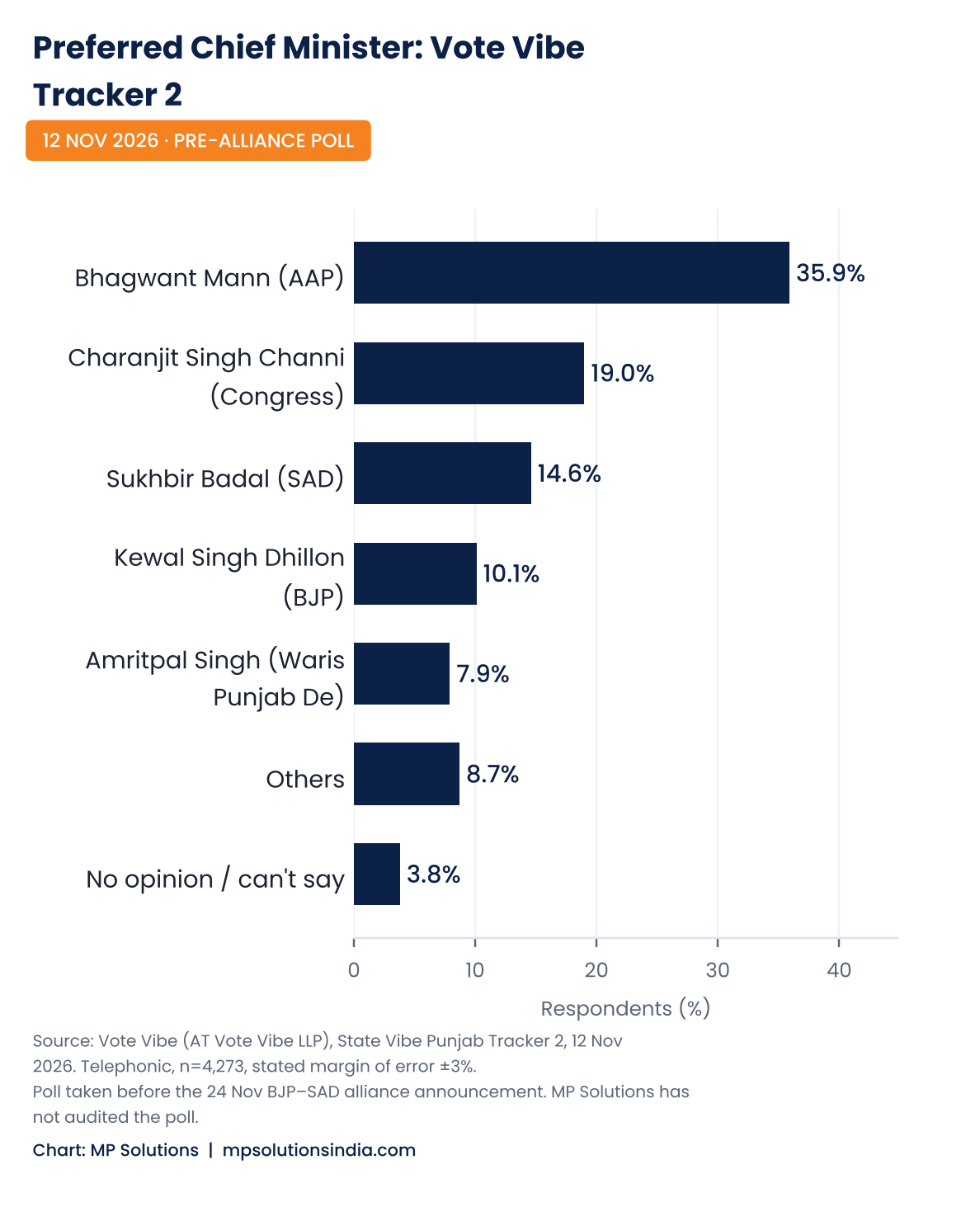
This is a preference question, not an announcement of party nominees. It was also asked before the BJP–SAD reunion.
What voters say are the biggest issues
Tracker 2 asked respondents to name the most important election issue. The leading answers were drug abuse (31.1%), unemployment and migration (23.0%) and law and order and women's safety (17.3%).
| Issue | Share |
|---|---|
| Drug abuse | 31.1% |
| Unemployment and migration | 23.0% |
| Law and order / women's safety | 17.3% |
| Inflation | 10.2% |
| Corruption | 5.1% |
| Education and healthcare | 4.7% |
| Farmers' issues | 2.8% |
| Infrastructure | 2.2% |
| Other / don't know | 2.1% |
| Social justice / caste equality | 1.4% |
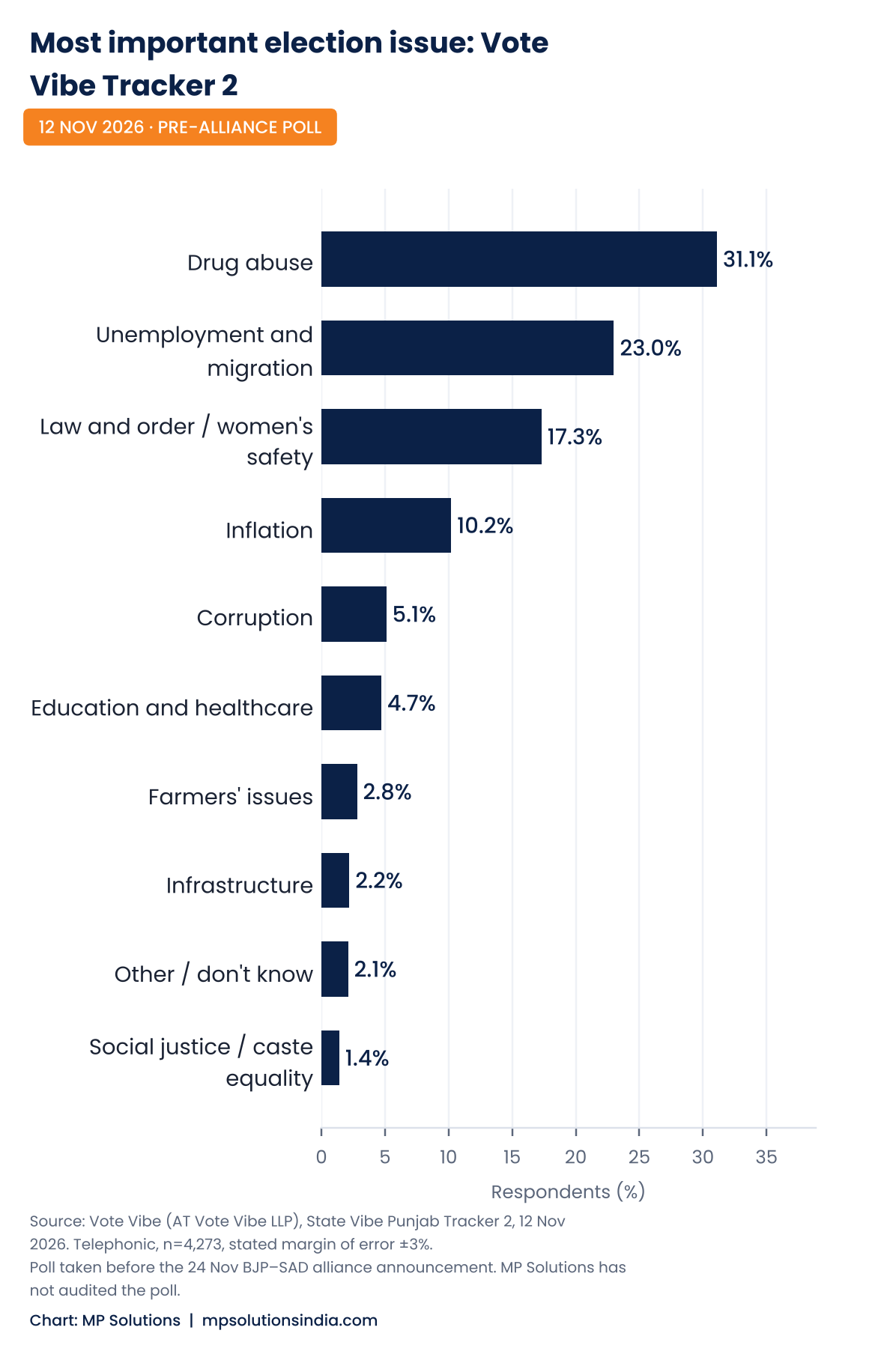
The poll's own breakdown shows drug abuse was named by 36.1% of rural respondents against 22.7% of urban respondents. Among urban respondents, unemployment and migration (27.5%) and law and order and women's safety (20.9%) ranked higher than they did statewide. These are survey findings, not independently verified measures of how widespread those problems are.
The three-region lens: Malwa, Majha and Doaba
Political commentary commonly divides Punjab into three broad regions. These are analytical and geographic groupings, not official Election Commission divisions.
| Region | Assembly seats | Why it matters |
|---|---|---|
| Malwa | 69 | Largest region; central to any statewide majority |
| Majha | 25 | Border belt with its own agrarian and religious-political dynamics |
| Doaba | 23 | The only region where AAP and Congress ran close in 2022 |
| Total | 117 |
Malwa alone has 69 seats, more than half the Assembly, and AAP won 66 of them in 2022. A Scroll.in analysis of the 2022 result found Doaba to be the one sub-region where the contest between Congress and AAP stayed close. Lok Sabha segment leads are not Assembly results, but the 2024 pattern is a warning against assuming the 2022 map will repeat.
Five questions that will shape the alliance's prospects
1. Can the BJP and SAD transfer votes to each other?
The two parties must turn separate historical support bases into coordinated constituency-level votes. A statewide addition of old vote shares is not enough. Candidate choice, local rivalries, campaign messaging and turnout can all disrupt transfers.
2. Can SAD rebuild trust after the 2020 split?
The farm-law dispute was the central reason for the breakup. The alliance will need to explain the reunion to voters, farmers and party workers. The reaction of farmer organisations should be tracked through public statements and constituency reporting, not assumed.
3. How will AAP defend its 2022 mandate?
AAP's 92-seat victory sets a high benchmark. Its campaign will be judged on governance, local MLA performance, public services, employment, drugs, law and order and the delivery of commitments.
4. Can Congress turn its 2024 performance into Assembly strength?
Congress won seven Lok Sabha seats in 2024 with a 26.30% vote share. Its challenge is to convert parliamentary support into a coherent Assembly campaign, manage leadership and candidate selection, and compete across all three regions.
5. What will the final seat-sharing formula be?
The 24 November announcement did not publish a constituency-by-constituency allocation. Reports of the BJP contesting around 40 seats remain unconfirmed until the parties formally announce them. The final allocation, candidate list and local arrangements will be major signals.
What can be concluded today?
The BJP–SAD reunion is a consequential change in Punjab's pre-election alignment. It gives the opposition a new structure to test, but it does not show that AAP has been defeated or that the alliance has a fixed vote bank. The 2022 result, the 2024 parliamentary election and the 12 November poll all point to a competitive, regionally varied contest.
The strongest evidence-based conclusion is that the 2027 election is open to significant realignment, but a reliable seat forecast is premature. The next useful step is constituency-level work: candidate strength, prior margins, 2024 Assembly-segment leads, local issues and credible post-alliance polling.
MP Solutions election tracker: what we will update
We will update this analysis when verified information is available on:
- Official BJP–SAD seat-sharing and candidate announcements.
- Party-wise and constituency-wise opinion polls with transparent methodology.
- Election Commission notifications, polling dates and final electoral-roll updates.
- Candidate affidavits and criminal and financial disclosures.
- Constituency-level historical results and 2024 Assembly-segment leads.
- Campaign developments and public statements from parties and farmer organisations.
Data and source note
2022 Assembly and 2024 Lok Sabha figures are Election Commission of India data as reported by PTI and other news organisations and compiled in Wikipedia. Voter-roll figures come from the Punjab Chief Electoral Officer's 12 October 2026 final-roll announcement as reported by PTI and All India Radio. The opinion poll is reproduced with attribution to Vote Vibe's 12 November 2026 Tracker 2. Alliance details are drawn from news reports dated 24 November 2026. Where poll methodology or media reports are cited, they are attributed rather than presented as official election data.
This article is a statewide, party-level analysis. It does not include a constituency-by-constituency (117-seat) results dataset, and it makes no seat projection.
Get election updates on WhatsApp. Unbiased, sourced updates from the MP Solutions Election Desk. Join our WhatsApp channel.
Want constituency-level survey data or vote-swing analysis for your campaign? Talk to MP Solutions.